A company is trying to figure out which stage of order fulfillment causes the biggest delays. The system shows the current status of every order, but it never records when a status changed. The team digs through logs and other sources and comes up empty. There is no complete history anywhere. Management can see the backlog. What it can't see is where the backlog forms. So it may well add people in exactly the wrong place.
Another company has every piece of data it needs. Once a week, someone pulls sales, stock levels and open orders from three different systems and stitches them together in Excel. The spreadsheet is fine. It just lands on the team's desk after the deadline for approving purchases has passed.
Neither company is getting what it could out of its data, each for a different reason. The first is missing part of the record. The second has the record but can't get it ready in time. A new report won't fix both, and neither will AI. Before you decide what to change, you need an honest picture of how the company actually works with data today.
Six ways of working with data
What follows are six situations you'll recognize, not a maturity scale for grading the whole company. Sales might run on polished reporting while production still lives on summaries built by hand. So look at one process or one area at a time, not at the business as a whole.
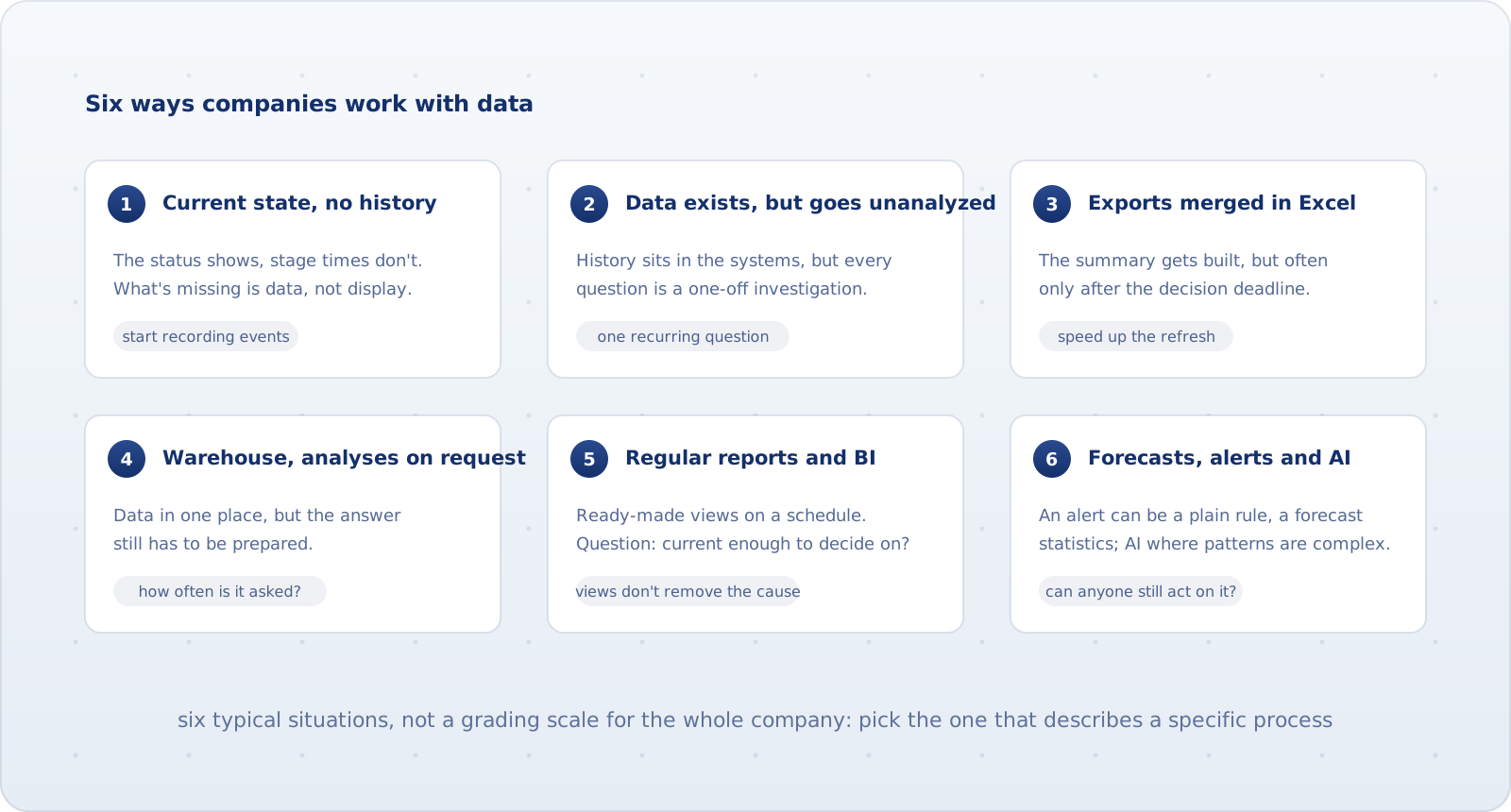
1. The current state is visible, the history isn't
The system says a complaint was closed. It doesn't say how long the customer waited for a first reply. It shows where an order is right now, but not how long it sat at each stage along the way.
This isn't a reporting problem. The information the analysis needs simply doesn't exist. The first thing to do is check whether a trail survives somewhere else: in logs, in documents, in another system. If it doesn't, you can start recording the relevant events and their timestamps from now on. From that point, each run of the process can be compared with the last.
That's worth doing when the history feeds a decision that keeps coming back. Just don't expect it to recover the months you didn't record.
2. The data exists, but hardly anyone looks at it
The systems hold years of sales, orders and support tickets. Yet when someone asks why complaints are climbing or margin is slipping, answering means a one-off investigation. Nobody returns to the data on a regular basis.
You don't need a data warehouse to fix this. Start with the one question that comes up in every meeting and build a simple view of how that number has moved over time. If the view helps someone decide something, make sure it gets refreshed regularly.
That's the key difference from the first situation: the information is already there. It's just not being used.
3. Exports from several systems, merged by hand in Excel
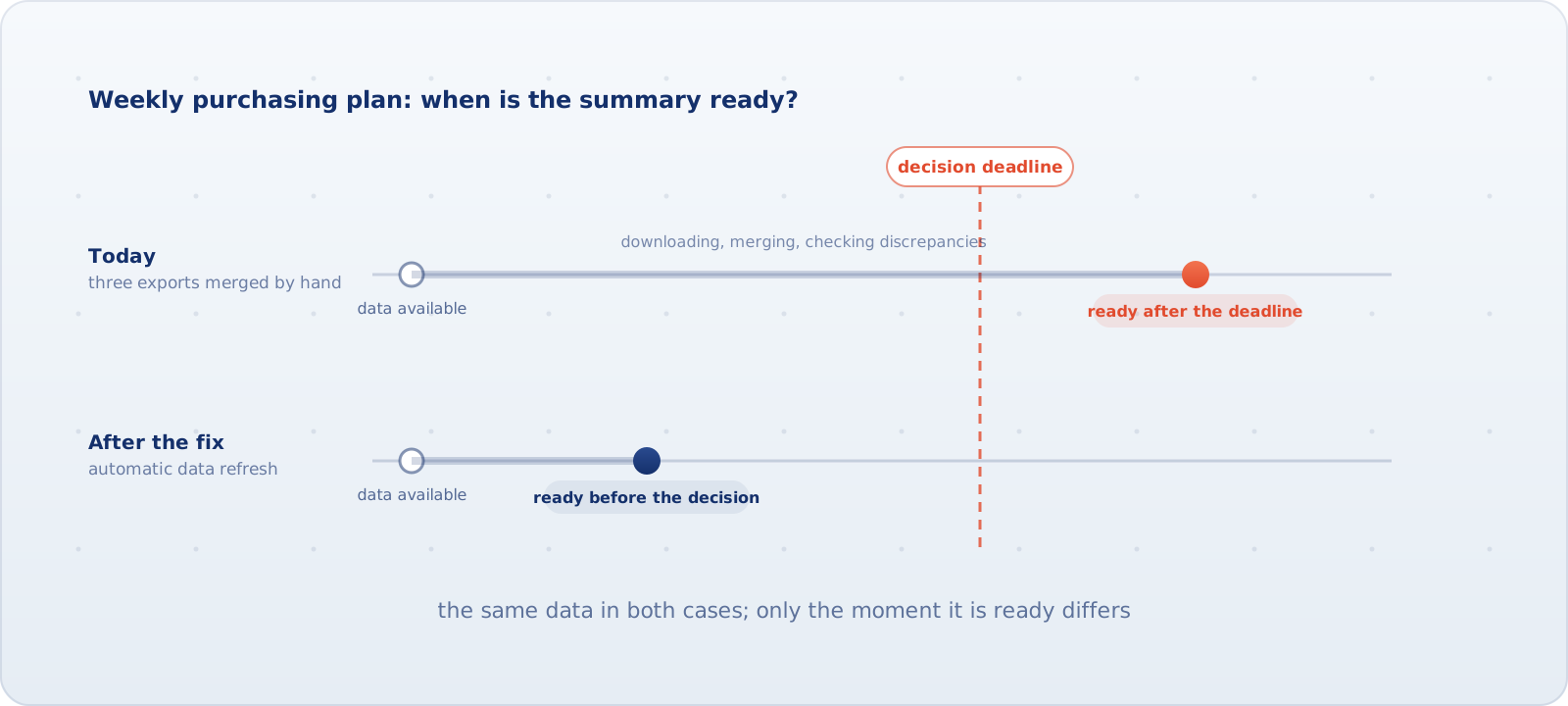
Say the company plans purchasing every week. It needs sales from one system, stock from another and open orders from a third. Someone downloads the three files, combines them and chases down the discrepancies.
That spreadsheet shows something no single system can, so Excel is doing real work here. The problem starts when preparing it takes so long that the picture arrives after the deadline for placing orders. The company decides blind, even though all the data existed days earlier.
In that case, speeding up the refresh is worth far more than the hours it saves. It means the data is there before the decision instead of after it. Often an automated import or a self-refreshing workbook is enough. Nobody has to give up Excel.
If the report is only needed now and then, and it's quick and reliable to produce by hand, the manual version may still be the sensible choice.
4. Data in one place, but every analysis still made to order
The company has a data warehouse, or at least a shared data set. The analyst no longer collects files from each system by hand. But when the board asks about a particular metric, the analyst still has to write a query, build a spreadsheet or put together a separate analysis.
That's not the same as regular reporting. Shared data shortens the path to an answer. It doesn't mean the answers are ready and waiting.
For unusual questions, analysis on demand makes sense. If the same metrics come back every Monday, though, a repeatable report serves everyone better. What tips the balance is how often the question recurs, not whether a warehouse happens to exist.
5. Regular reports and BI
Managers open a ready-made report on sales, costs or plan versus actuals. A BI tool lays it out in tables and charts and refreshes it on a schedule.
Most of the effort of rebuilding the same summary every time disappears. Results are easier to compare and deviations easier to spot. The question that remains is whether the report is fresh enough for the decision it's meant to support. Data refreshed once a day is fine for a weekly review and too stale for some day-to-day operational decisions.
Some companies have a dozen dashboards and still commission one more report before every important meeting. Adding another view at that point doesn't touch the underlying problem.
6. Forecasts, alerts and AI
Analysis can also look forward. The company gets a warning about a likely stock shortage, a demand forecast or a suggestion for which ticket to pick up first.
It helps to keep three things apart. An alert can be a plain rule, like a threshold being crossed. A forecast can come from standard statistics. AI earns its place where the patterns are too complex for simpler methods. Not every warning and not every forecast needs artificial intelligence (we've written separately about when an LLM is really needed).
What makes any of this valuable is whether someone can act on it. A shortage warning helps when there's still time to change the order or the delivery date. If it arrives too late, even a perfectly accurate model changes nothing.
AI doesn't automatically mean building a warehouse or replacing your systems. It does mean having reliable access to data you can trust, the right permissions and a business case that holds up. Depending on where you start, that's either a small extension of an existing process or a serious integration project.
Why this isn't a ladder
A company that makes one monthly decision from a single spreadsheet, refreshed correctly and on time, may already have everything that decision requires. Swapping the spreadsheet for a BI platform will raise costs without necessarily improving the outcome.
Another company may have a warehouse and dozens of dashboards and still not get an answer to its most important question when it matters.
So there's no obligation to climb from the first situation to the sixth, and no obligation to end up at AI. What justifies an investment is the constraint it removes, not how modern the tool is.
When a small change makes a big difference
Back to the weekly purchasing plan. If the information already exists and the only thing delaying the decision is a manual merge, fixing that one summary can get the decision made on time, and no major IT project is required. How much that's worth depends on how often the problem recurs and how important the delayed decision is.
That's a possibility, not a rule. When the data was never captured, is full of gaps or can only be combined at great expense, even a change that looks simple can turn out to be hard. And automating a report nobody reads helps no one.
Companies that make little use of their data may have easy wins waiting. But not necessarily. Before you invest, check two things: will the new information arrive in time, and will someone actually do something with it?
What a CEO should do
Rather than planning a new platform, pick one business question that comes back regularly. Find out where the data for it comes from, how long the answer takes to produce and whether it's ready before the decision has to be made. From there, three outcomes are all perfectly reasonable.
Leave it as it is. If a spreadsheet that can be refreshed quickly and correctly serves a monthly decision, and the result is used on time, you don't need a new system just to retire Excel.
Fix the repeated work. If someone merges the same exports by hand every week and the report still arrives late, look at automating the pull or the refresh. Start with the one summary people actually use, not with rebuilding all of reporting.
Start recording what's missing. If nobody can say how long each stage of an order took, check what event trails already exist. If the history genuinely isn't there, decide which status changes and dates to capture from now on.
Each of these answers a different problem. None of them requires moving up to a more advanced technology just for the sake of it.
Before you plan the next investment, look at the last important decision in the process you picked. Was the information you needed on hand while there was still time to act on it?
And if it was, and the decision still stalled? That's what the next part is about.