AI Fraud Detection for Cashback Programme
Industry
Technologies


Country
Client Overview
ZipZero is a UK cashback platform that was used daily by hundreds of thousands of people. Users scan shopping receipts, and the money they earn goes toward household bills. We have been ZipZero's engineering partner for years, responsible for the platform's architecture, mobile app, and receipt OCR. As the platform grew, so did abuse. Receipts arrived with amounts altered by hand, the same receipt was submitted through several accounts, and some users appeared to shop in two distant cities within the same hour. Individually these were small amounts; at the platform's scale they added up to a significant leak in the company's budget. We built an AI tool that scored every incoming receipt before cashback was paid out and routed suspicious cases to human review.
Client Needs

Fraud at cashback scale

ML scoring before every payout

Protecting the company's budget

Human review for unclear cases
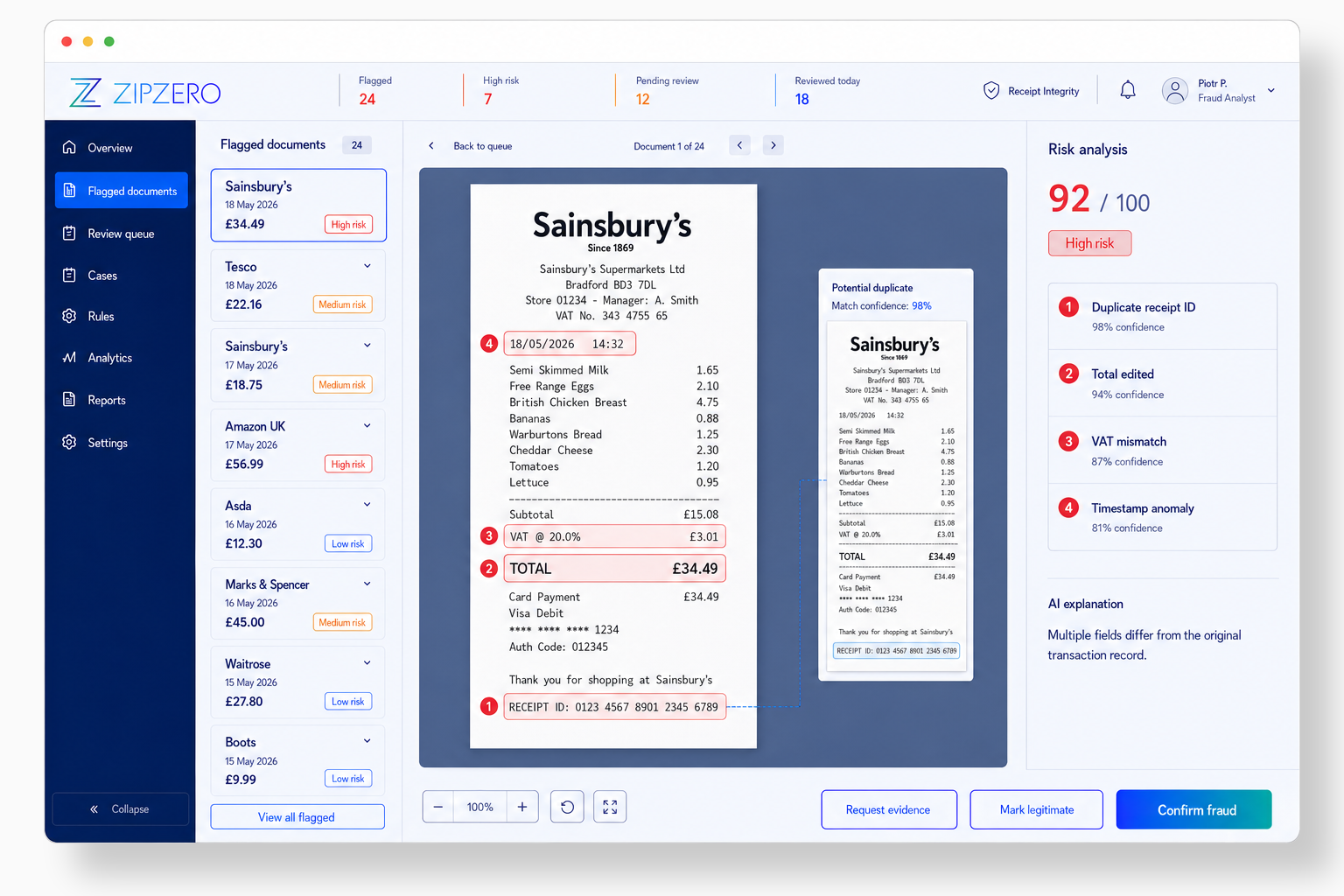
Manual spot checks could not keep up with the volume, and simple rules failed both ways. Strict ones punished honest users, lenient ones let fraud through. ZipZero needed risk scoring built into the receipt handling process itself. Every submission was to be assessed before payout, suspicious cases sent to a person instead of being rejected automatically, and the whole thing fast enough not to delay payouts for honest users.
Services Provided
Altered amounts: A digit added by hand after the printed total slips past plain OCR. The system cross-checks extracted totals against the receipt's line items and flags amounts that do not add up.
Location and time anomalies: Purchases from one account in two distant locations within the same hour. Location and timing patterns across an account's history expose receipts that cannot belong to one shopper.
Duplicate receipts: The same receipt submitted again: cropped, re-photographed, or sent from another account. Duplicate detection works across the whole user base, not just within one account.
Behavioural scoring: Submission bursts and frequency patterns inconsistent with normal shopping, detected over each account's history.
Combined signals: Signals from the receipt image, from the extracted data, and from user behaviour are scored independently and combined, so a new trick has to get past all of them at once.
Human review: Suspicious receipts go to a review queue instead of automatic rejection, which protects honest users from false positives. Reviewer decisions feed back into model training.
Scope of Work
We designed and built the fraud detection capability inside the platform we run for ZipZero.
Analysing confirmed fraud cases with ZipZero's team to map the methods actually in use: altered totals, duplicate receipts, coordinated accounts, and location anomalies.
Defining the fraud signals across three areas. Some show up in the receipt photo itself, some in the extracted data, and some only in an account's history of behaviour.
Building the scoring models and validating them in shadow mode against human verdicts before they affected a single payout.
Integrating scoring into the payout path, so every receipt is assessed before cashback is released, without delaying honest users.
Building the review workflow for flagged receipts, with reviewer decisions flowing back into model training.
Monitoring how fraud patterns change over time and extending the detection signals when new methods appear.
Technologies Used




Development Process
The fraud system grew out of our long-running work with ZipZero. We knew the platform and the receipt data inside out, so we knew where the data was reliable and where fraud could hide. We started the way we run every process automation: with a pilot on a narrow slice. The models scored receipts in shadow mode, blocking nothing, and their verdicts were compared against human decisions until the results justified putting the scoring on the payout path. From there we kept extending the tool to handle more and more cases: from altered amounts, through duplicates across accounts, to shopping patterns that could not be real. The goal was to change the economics of fraud rather than catch every case immediately. Once altered receipts stop paying out, most attempts simply stop. The review queue keeps people on the ambiguous cases, and their decisions continuously improve the models.
Check our work on ClutchWhat our clients say

The expertise of the leaders, coupled with the diverse skill sets of their teams, truly sets them apart. Their vast experience across a myriad of projects ensures that they can adeptly handle virtually any project you envision. Furthermore, their deep involvement in the process is palpable; it's as if they seamlessly integrate and become an intrinsic part of your in-house development team.