AI Micro Campaign Targeting Platform: Genie Vision
Industry
Technologies


Country
Client Overview
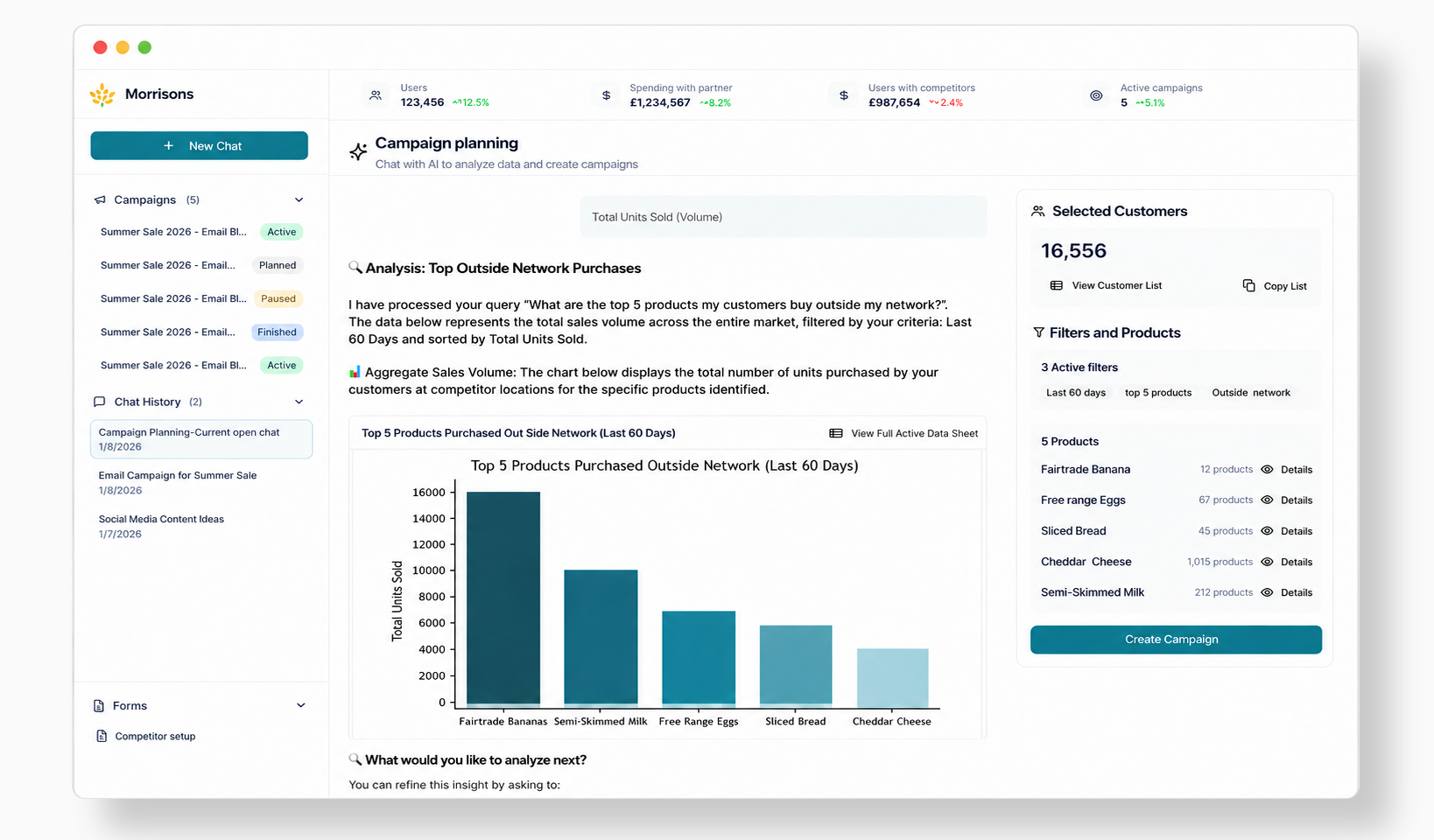
Genie Vision is a B2B product for retail chains, built on the purchase data collected by the Vault consumer app. A chain sees transactions in its own stores, but not what its customers buy elsewhere; the receipt data covers that missing part and makes it usable for marketing. The product replaces traditional campaign forms with a conversation. An operator asks in plain language which products customers buy outside the network or who has stopped visiting, receives answers with charts, narrows the results down to a precisely defined audience, and launches a campaign with a personal offer, measured through to redemptions and ROI. We built the product in stages. An interactive prototype came first, so the full flow could be tested before any backend was built. After the tests came back positive we built the production version, and today Genie Vision is under active development.
Client Needs

Campaigns built through conversation

Behavioural targeting on purchase data

Insight into what customers buy at competitors

Campaign ROI measurement
The key requirement was operator trust in the AI. A marketing team will not send an offer to thousands of customers based on criteria it cannot inspect. So a conversation with the AI ends in a readable list of criteria the operator approves before launch, the audience size is recalculated with every change, and campaign results, from cost to attributed revenue, stay visible through to the end.
Services Provided
Conversational analytics: The chat answers with data: charts, competitor breakdowns, and tables appear directly in the conversation, and ambiguous questions get clarifying options instead of a guess.
Criteria the operator can check: Before a campaign launches, the operator sees exactly who it will reach: how often those customers buy, how much they spend, which categories they choose, and whether they gave marketing consent. The audience size updates with every change to the criteria.
Competitor product mapping: Receipt line descriptions are unified into the common product taxonomy, the same one that organises data across the platform. A campaign can therefore reach, for example, people who buy a specific product at a competitor, and the operator sees immediately how many such people there are.
Campaign creator: A step-by-step wizard from product and audience to the offer itself (a monetary discount or a described benefit), duration, customer-facing copy, and an audience export ready for the chain's POS system.
Campaign measurement: Every campaign is measured by its results: how many people it reached, how many offers were redeemed, what it cost, and what revenue can be attributed to it. The chain also sees how much of its customers' shopping it captures and how much it loses to competitors.
Scope of Work
We designed the product and took it from prototype to production.
Designing the conversational campaign flow: from a plain-language question, through charts and clarifications, to a verified audience and a launched campaign.
Designing the interactive cards used inside the conversation: audience insight, cohort lists, competitor product mapping, and campaign creation.
Modelling the targeting criteria on real purchase data: frequency, basket value, categories, loyalty, recency, and purchases at selected competitors, with live audience sizing.
Building the campaign creator with monetary and descriptive offer types, customer-facing copy, and audience CSV export for POS integration.
Designing the measurement layer: campaign KPIs from reach to redemptions, conversion, attributed revenue, and ROI, plus a partner dashboard showing how much of customers' shopping the chain captures and how much goes to competitors.
Building the product in stages: first a React and TypeScript prototype on simulated data, tested with users, then, after positive results, the production version we actively develop today.
Technologies Used




Development Process
We started with a working application on simulated data instead of a slide deck. The full flow, from a question through insight and audience to campaign and results, could be shown to retail chains and tested with users before any decision about the backend. After the tests came back positive, we built the production version on proven parts of the platform: the conversational analytics follows the same pattern as the assistant we built for Vault, and the targeting runs on the document processing already working in production. Genie Vision is live and under active development.
Check our work on Clutch