Multi Agent AI Assistant for Genie Vault
Industry
Technologies


Country
Client Overview
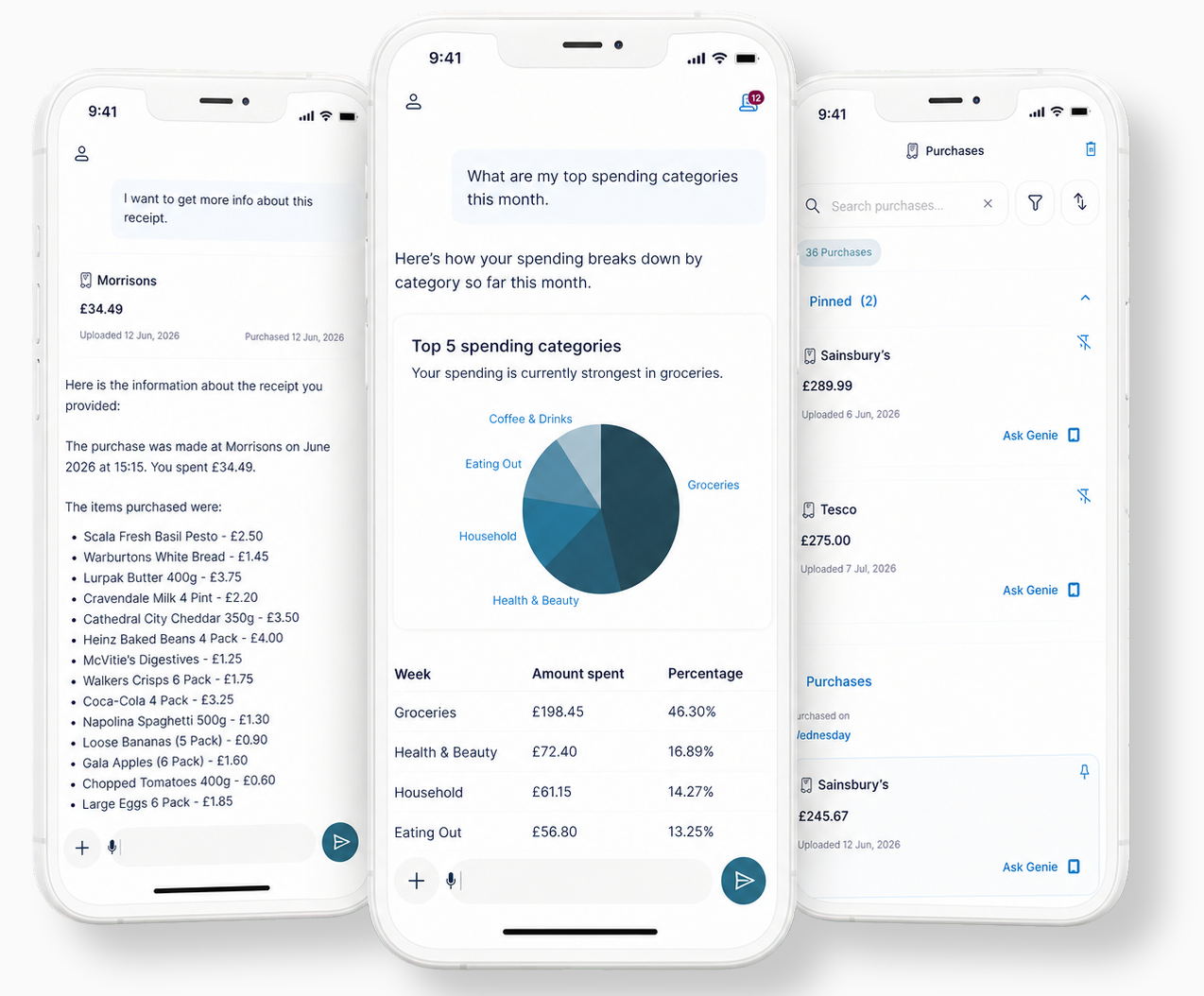
Genie Vault is a consumer app for the UK market built around a simple idea: every purchase, finally useful. Users scan paper receipts with their phone or forward online order confirmations to a personal address in the app. Each purchase becomes part of their personal shopping memory, broken down into products, prices, retailers, and dates. Genie, an AI assistant users talk to in plain language, draws on that memory. Where a bank statement shows only the amount of a transaction, Genie knows what was actually bought: it answers questions about spending, compares shops, shows trends as charts inside the chat, and surfaces offers shaped around what the user really buys. Because the assistant deals with users' money, its answers have to be based strictly on real purchase data. The app is live on the UK market in open beta, and its value stands on two things: the quality of the purchase data and the trust users can place in every answer Genie gives.
Client Needs

An assistant that answers from real purchase data

Independence from any single AI provider

Predictable cost and response times

Full visibility into what the AI does
The assistant had to handle the way people actually write: several requests in one message, vague questions that need a follow-up, long conversations. At the same time the platform needed predictable model costs at consumer scale, resilience to outages of a single AI provider, and full insight into what the AI does and why. All of this inside a platform of more than a dozen microservices, developed in parallel with the assistant itself.
Services Provided
Multi-agent architecture: A routing agent breaks each user message into individual requests and passes them to specialised agents: adding receipts, spending statistics, FAQ answers, and general conversation. A summary agent combines the results into one reply, and ambiguous questions get a clarifying follow-up instead of a guess.
Answers based on real data: Agents access purchase data only through a controlled set of tools, with safeguards and automatic retries. Strict rules ensure that every amount in a reply comes from the user's actual data, and when the data is missing, the assistant says so.
Multi-provider model layer: The assistant works with models from several providers behind one shared interface, including models running on private infrastructure. Switching models is a configuration change, which keeps the product independent of any single provider's outages or pricing.
Cost control: Built-in budget limits cap the cost of each conversation, and long chats are summarised along the way, so model costs stay predictable as the user base grows.
An assistant that adapts to the user: A new user with three receipts gets different answers and guidance than someone with a year of purchase history. The app assesses how complete a person's shopping picture is, adapts the conversation to it, and suggests what is worth adding.
Charts in the conversation: For statistical questions the assistant marks where a chart belongs, and the mobile app renders it natively inside the chat.
Full insight into what the AI does: Every conversation is recorded together with the data the assistant used, how long the answer took, and what it cost. When something looks off, the team can replay exactly what happened.
Scope of Work
We build Genie Vault end to end: backend, AI, and mobile.
Designing the multi-agent architecture: message routing, specialised agents, summary composition, and clarification flows for ambiguous requests.
Building the layer that serves models from different providers behind one interface, with per-agent model and parameter configuration.
Implementing the tool layer that gives agents safe, controlled access to receipt and statistics data, with retries and budget limits.
Developing the React Native mobile app: receipt scanning, chat, purchase history, and native chart rendering.
Building the internal operations console for inspecting conversations, AI interactions, and data quality across the platform.
Running the platform on GCP with Kubernetes, Helm, and Terraform, including the event-driven Pub/Sub backbone between services.
Technologies Used






Development Process
The engagement started with analysis: we mapped the conversations users would actually have and agreed what a good answer means. On that basis we built a pilot meant to answer two questions: does the idea work, and will users actually use an app like this. The client put it through testing, including consumer tests, and only the positive results opened the decision to keep building. Since then we have been expanding the system iteratively: new capabilities reach users after tests on real conversations, and the whole platform is built to run without us. Request limits and hard budget caps protect it, and every answer can be traced back to the data it came from.
Check our work on Clutch